- Home
-
Products
Turn-key Project
- Battery Slurry Production Equipment
- Liquid Complete Production Line
- Adhesive Complete Production Line
- Powder Complete Production Line
- Liquid Storage and Automatic Batching System
- Powder Storage and Automatic Batching System
- EPC Project General Contracting Business
- Water-based Paint Production Line
- Putty Complete Production Line
- System Integration
- Application Industries
- News
- Service
- About Us
- Contact Us







-
- High Viscosity Mixers
- Dispersers&Mills
- High Shear Emulsifiers
- Grinding Machines
- Vacuum Drying Mixers
- Powder Blenders
- Extrusion Machine
- Washing Machine
- Powder Procedure Processing
- Filling And Packing
- Filters And Sieves
- Kettles/Vessels/Tanks/ Hoppers
- Laboratory Equipment
- Batching And Metering
- Turn-key Project
F108-25 Grease Production Line
 Project Background
SIEHE Group has built the first high-performance grease production line for a well-known petrochemical enterprise in North Africa, empowering the customer to step into the field of high-end grease manufacturing. Having years of experience in lubricant production and sales, this cooperation marks the second collaboration between both parties following the lubricant production equipment project in 2021, which fully demonstrates the customer’s high recognition of SIEHE’s equipment quality and technical strength.
Project Overview
Project Location: North Africa
Processed Materials: Lithium-based grease, complex lithium-based grease, etc.
Capacity: 4000 L per batch
Process Flow
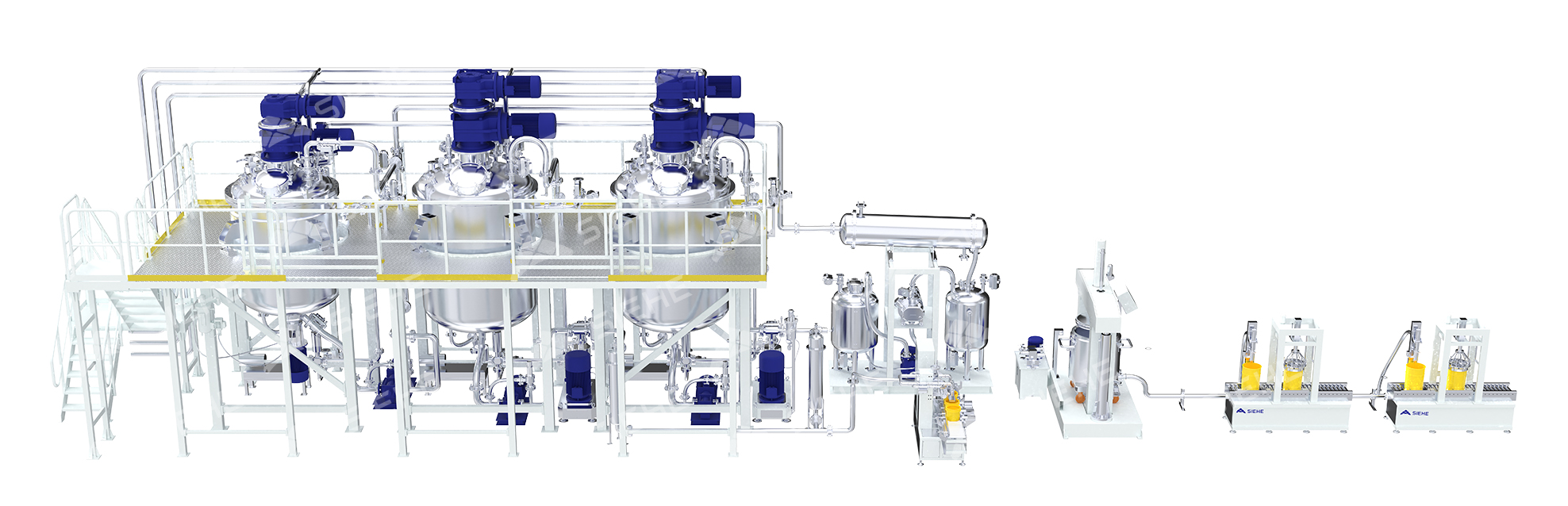
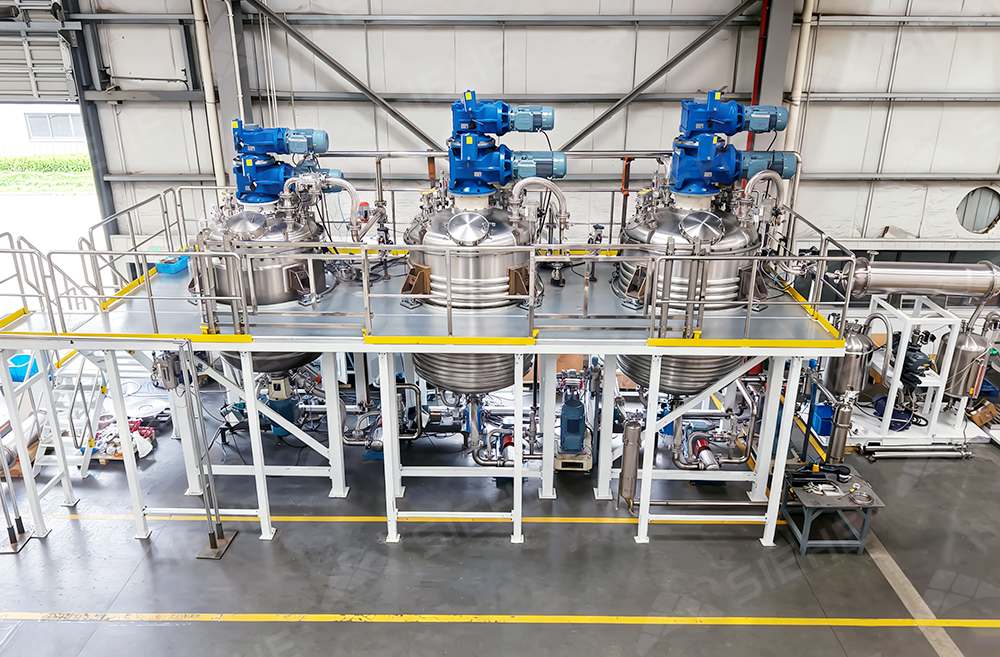
A customized high-performance grease production line is developed according to the customer’s material properties and process requirements. The production line consists of raw-material conveying & dosing system, pressure saponification system, blending & homogenization system, vacuum system, finished-product filling system, control system and other units.
1) Raw-Material Conveying & Dosing System
Liquid raw materials such as base oil are delivered by gear pumps from storage tanks to the 3000 L saponification reactor and 5000 L blending reactor respectively. Both reactors are equipped with Mettler-Toledo weighing sensors with accuracy up to 3‰. Material feeding adopts the incremental batching method. Weight signals are transmitted to the PLC in real-time to precisely control feeding quantity and guarantee formulation accuracy.
2) Pressure Saponification System
Liquid raw materials are pumped into the saponification reactor according to formulation ratios, and heated up through the jacket with flow deflectors. Multiple sets of combined agitators are installed inside the reactor. The bidirectional agitator plus SIEHE self-developed bottom-mounted high-speed propeller promotes overall material circulation and enhances heat-transfer efficiency. Materials complete the saponification reaction under high-temperature and high-pressure conditions to form uniform and fine soap-base structure. Upon completion of saponification, cooling medium is introduced into the jacket to cool materials down to a specified temperature. Afterwards, soap base is hermetically transferred to the mixing reactor via special triple-screw pumps with zero material exposure and loss.
3) Blending & Homogenization System
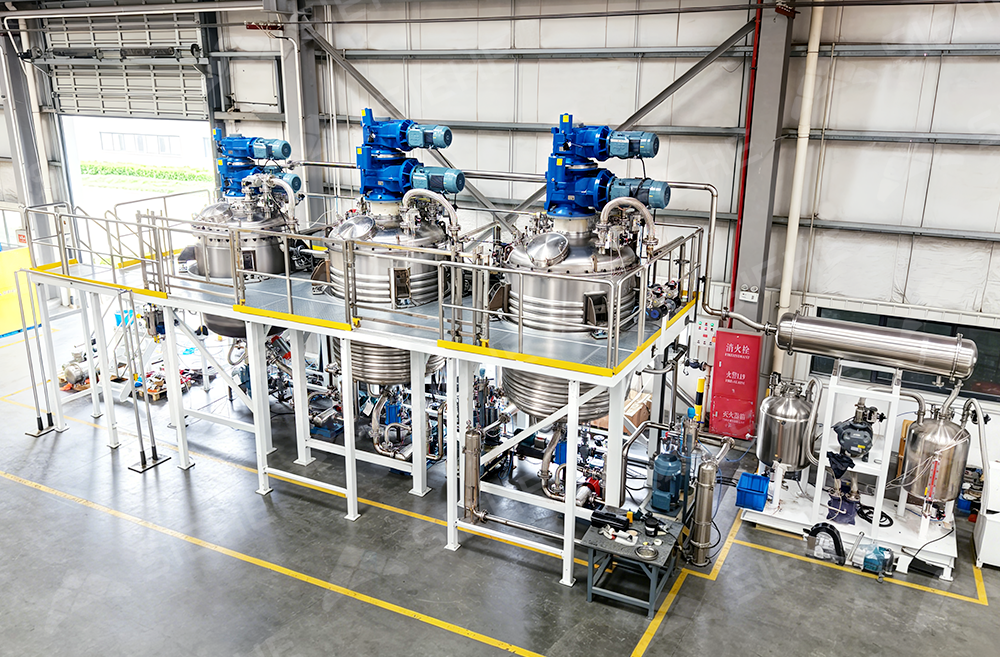
Once the soap base is fed into the blending reactor, precisely metered base oil is added following the formula specifications. The jacket-mounted heating system is activated simultaneously. Under the action of the combined mixing unit, the mixture undergoes continuous agitation for 1-2 hours, allowing the soap base to fully swell and evenly disperse within the base-oil system. Various performance additives are introduced during this mixing cycle in line with formula requirements. Sustained agitation ensures even distribution of additives to complete the blending phase.
To deliver superior fineness and stability for the final grease product, the production line is fitted with two SMK colloid mills for high-shear homogenization of blended materials. Custom-built triple-screw pumps transport materials to the colloid mills. Driven by powerful shear forces from multi-stage toothed rotor-stator sets, materials undergo ultra-fine dispersion and high-efficiency homogenization. This thoroughly refines the soap-fiber structure and boosts the grease’s mechanical stability and smooth texture. The rotor-stator clearance supports stepless adjustment, enabling operators to flexibly set optimal parameters for different process conditions. Homogenized materials flow back into the blending reactor through pipelines to build an external circulation loop. The cyclic shearing process keeps running until the material fineness reaches target standards.
4) Vacuum System
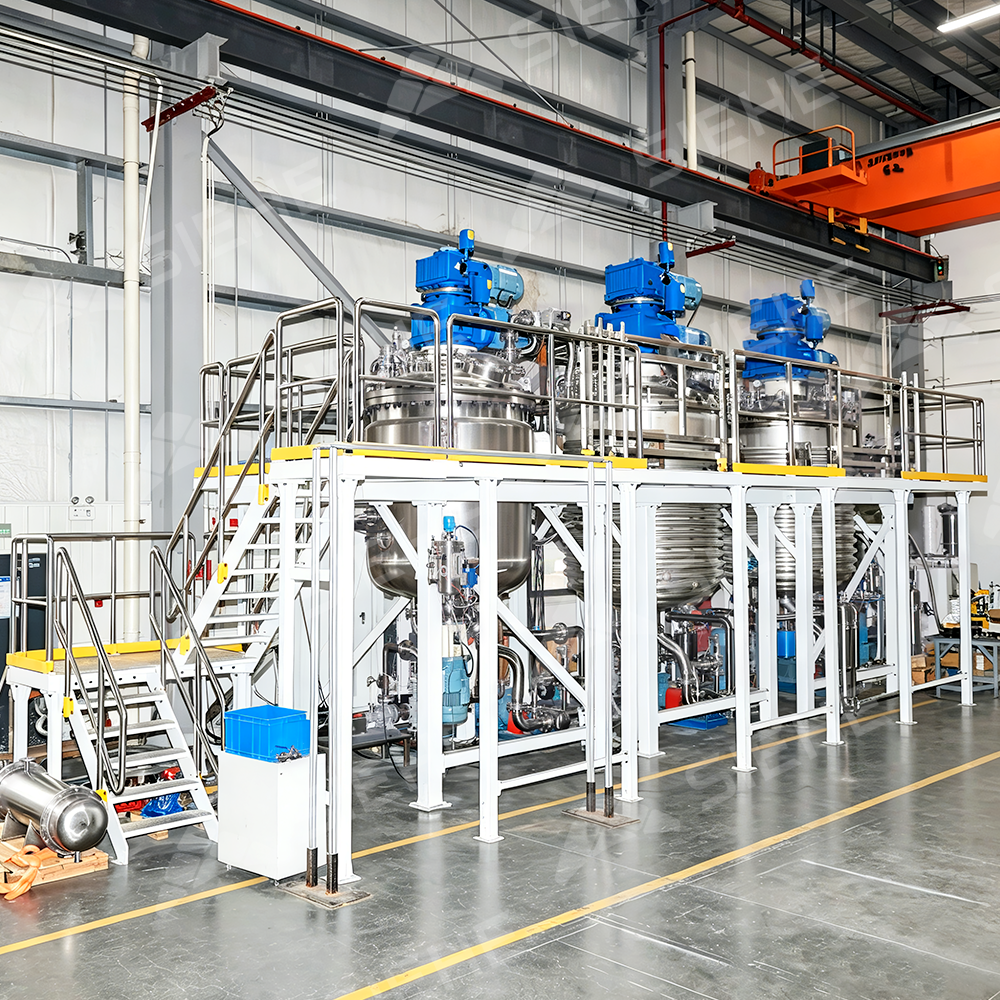
Composed of water-ring vacuum pumps, Roots pumps and matched horizontal condensers, this system can connect with both saponification reactor and blending reactor. It provides high-vacuum environment for low-temperature and high-efficiency material dehydration and drying. Meanwhile, it rapidly eliminates bubbles inside materials to increase product density and improve appearance and overall quality of finished products.
5) Finished-Product Filling System
Finished grease can be connected to semi-automatic 200 L drum filling machines for large-drum packaging, or semi-automatic small-drum filling machines (1-5 kg / 5-20 kg) for small-size packaging, depending on packaging demands. All filling units adopt high-precision Mettler-Toledo weighing modules for accurate metering and stable operation.
A hydraulic extruder is additionally configured for repackaging 200 L drum finished grease into smaller sizes. The extruder conveys materials to semi-automatic small-drum filling machines to realize precise repackaging for corresponding specifications
6) Control System
Independent electric control cabinets adopt Siemens PLC + touch-screen for centralized control. Operators can manage start-stop and rotating speed of pumps and agitators, valve on-off status, colloid-mill operation, vacuum degree, heating / cooling and other processes. The system supports formula storage, production-data traceability and fault early-warning, featuring convenient operation and high intelligence.
Conclusion
Integrating raw-material conveying, pressure saponification, high-shear homogenization, vacuum degassing and intelligent control, this complete grease production line satisfies manufacturing requirements for grease of diverse viscosity grades and properties. It greatly boosts production efficiency and consistency of finished products. Once the production line is operational, the production line will deliver solid equipment support for the customer to explore high-end grease markets and optimize product portfolios, further consolidating its leading position in North Africa’s petrochemical industry.